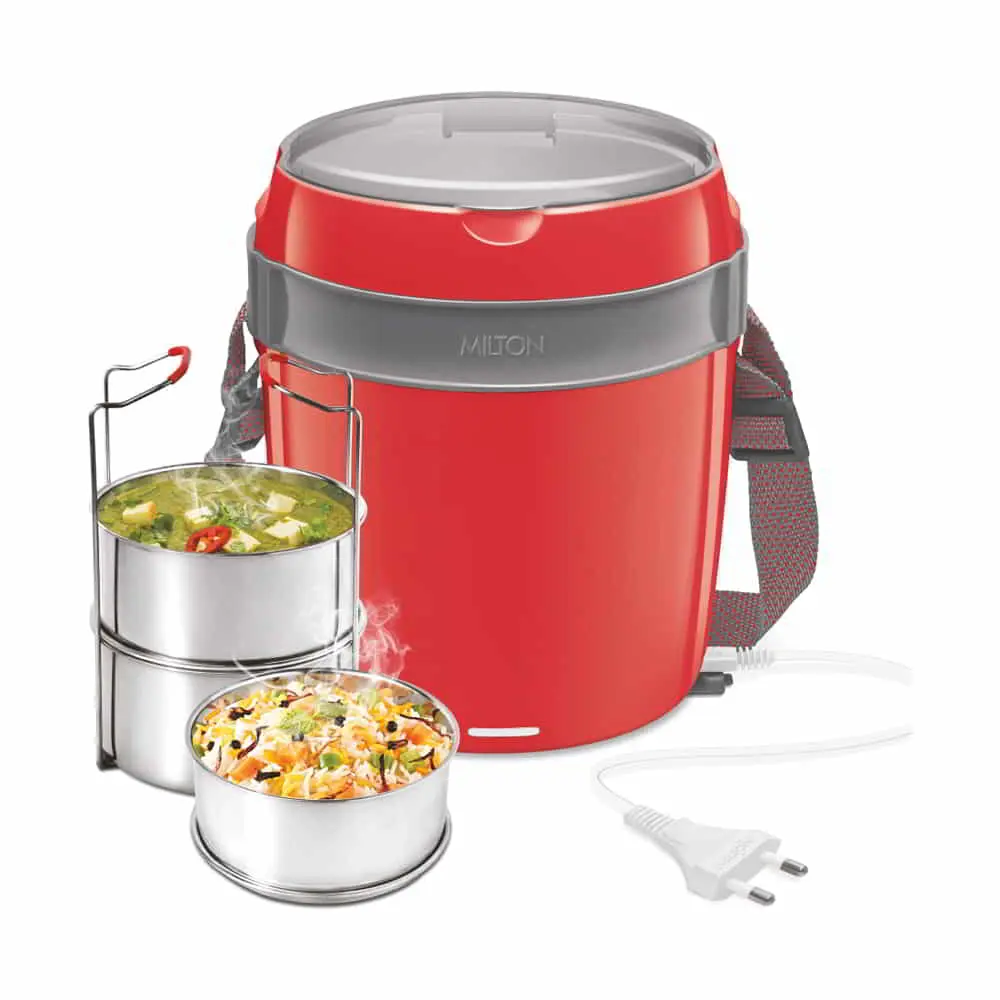
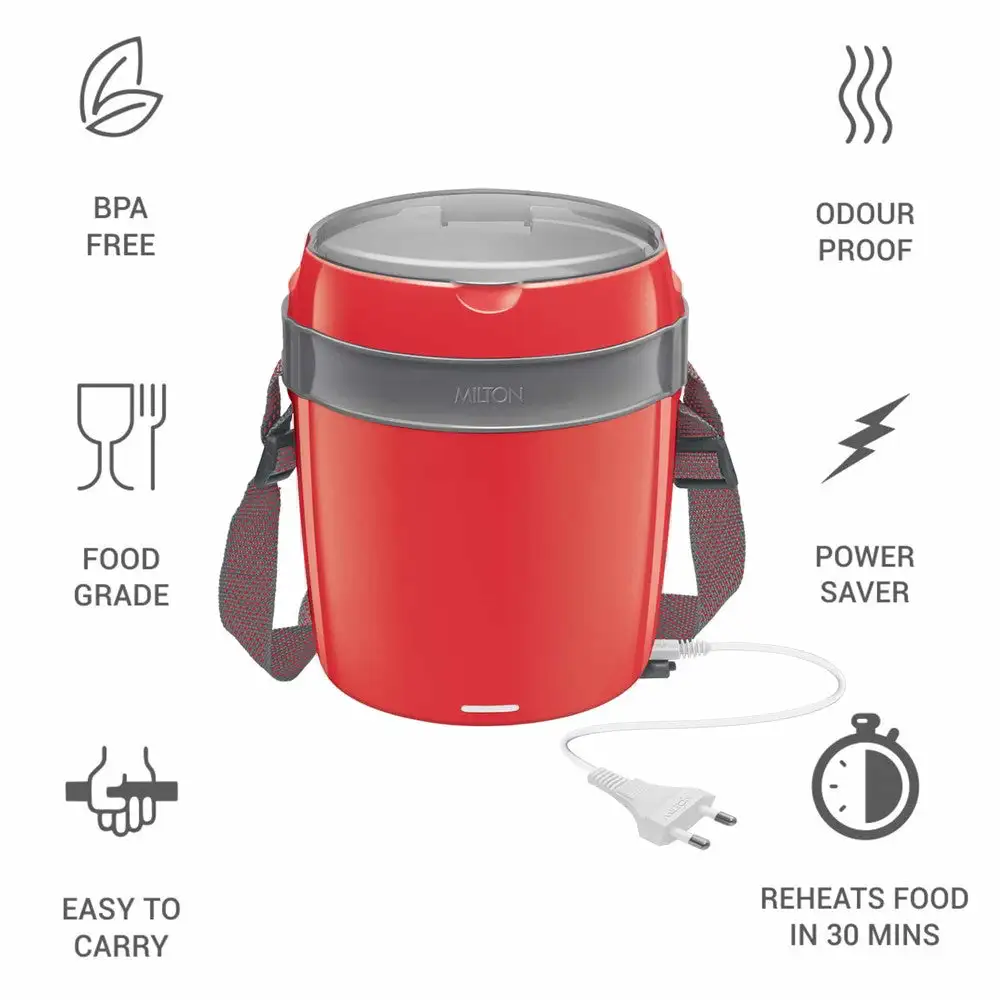
ऑफिस में लंच लेकर जाना तो आसान है, लेकिन कई बार लंच टाइम तक खाना ठंडा हो जाता है। खासकर सर्दियों में गर्म खाना खाने का मन हो, तो ठंडा टिफिन परेशानी बन सकता है। ऐसे में Electric Lunch Box एक उपयोगी विकल्प हो सकता है।
MILTON Futron Electric Lunch Box उन लोगों के लिए एक विकल्प है जो घर से खाना लेकर जाते हैं और जरूरत पड़ने पर उसे इलेक्ट्रिक तरीके से गर्म करना चाहते हैं। लेकिन क्या इसे खरीदना सही रहेगा? इसकी खासियतें क्या हैं, किन बातों का ध्यान रखना चाहिए और खरीदने से पहले कौन-सी जानकारी चेक करनी चाहिए? आइए विस्तार से जानते हैं।
इस पोस्ट में आप जानेंगे:
MILTON Futron Electric Lunch Box की मुख्य विशेषताएँ
यह किस तरह काम करता है
ऑफिस और रोजाना इस्तेमाल के लिए कितना उपयोगी हो सकता है
खरीदने से पहले किन बातों की जाँच करनी चाहिए
किन लोगों के लिए यह सही विकल्प हो सकता है
MILTON Futron Electric Lunch Box: एक नज़र में
विशेषता
जानकारी
ब्रांड
MILTON
प्रोडक्ट
Futron Electric Lunch Box
कैटेगरी
इलेक्ट्रिक लंच बॉक्स
इस्तेमाल
ऑफिस, यात्रा और रोजाना लंच
पावर
खरीदते समय मौजूदा मॉडल की स्पेसिफिकेशन चेक करें
कंटेनर
उपलब्ध वेरिएंट के अनुसार
वारंटी
Amazon की मौजूदा लिस्टिंग और ब्रांड की शर्तें देखें
नोट: मॉडल, कंटेनर की संख्या और स्पेसिफिकेशन अलग-अलग लिस्टिंग में भिन्न हो सकते हैं। ऑर्डर करने से पहले Amazon पर दिए गए प्रोडक्ट विवरण को जरूर चेक करें।
MILTON Futron Electric Lunch Box कैसे काम करता है?
Electric Lunch Box का उद्देश्य खाने को इलेक्ट्रिक हीटिंग के जरिए गर्म करना है। सामान्य टिफिन की तरह इसमें घर से खाना रखा जा सकता है, लेकिन इस्तेमाल के समय इसे संबंधित मॉडल के निर्देशों के अनुसार बिजली से कनेक्ट किया जाता है।
यहाँ एक जरूरी बात समझना चाहिए: इलेक्ट्रिक लंच बॉक्स हमेशा तुरंत खाना गर्म नहीं करता। हीटिंग में लगने वाला समय खाने की मात्रा, शुरुआती तापमान और मॉडल पर निर्भर कर सकता है। इसलिए खरीदने से पहले प्रोडक्ट की आधिकारिक जानकारी और इस्तेमाल के निर्देश पढ़ना बेहतर है।
MILTON Futron Electric Lunch Box के संभावित फायदे
1. ऑफिस में गर्म खाना खाने का विकल्प
अगर आप रोजाना घर से लंच लेकर जाते हैं, तो इलेक्ट्रिक लंच बॉक्स आपके लिए उपयोगी हो सकता है। यह उन लोगों के लिए खास तौर पर प्रासंगिक है जिनके ऑफिस में निर्धारित समय पर माइक्रोवेव उपलब्ध नहीं होता।
2. घर का खाना साथ ले जाना
बाहर से खाना मँगाने के बजाय घर का बना खाना साथ ले जाना सुविधाजनक हो सकता है। हालांकि, खाने को सुरक्षित तापमान पर रखने और गर्म करने के लिए मॉडल के निर्देशों का पालन करना जरूरी है।
3. रोजाना इस्तेमाल के लिए उपयोगी डिजाइन
खरीदने से पहले कंटेनर की संख्या, उनकी क्षमता, ढक्कन की फिटिंग और पूरे टिफिन को साफ करने की सुविधा जरूर देखें। ये बातें रोजाना इस्तेमाल में काफी मायने रखती हैं।
4. ऑफिस जाने वाले लोगों के लिए एक अलग विकल्प
जिन लोगों को रोजाना लंच पैक करना पड़ता है, उनके लिए यह सामान्य टिफिन से अलग सुविधा दे सकता है। लेकिन यह कितना उपयोगी रहेगा, यह आपके ऑफिस की बिजली की सुविधा, लंच टाइम और खाने की आदतों पर निर्भर करेगा।
खरीदने से पहले इन 5 बातों पर ध्यान दें
1. हीटिंग में कितना समय लगता है?
अगर आपका लंच ब्रेक छोटा है, तो यह सबसे जरूरी सवाल है। प्रोडक्ट की लिस्टिंग में दिए गए हीटिंग टाइम को देखें और समझें कि वास्तविक समय खाने की मात्रा और तापमान के अनुसार बदल सकता है।
2. कंटेनर की क्षमता कितनी है?
अगर आप सिर्फ एक व्यक्ति के लिए खाना ले जाते हैं, तो छोटी क्षमता पर्याप्त हो सकती है। लेकिन अगर आप ज्यादा खाना या अलग-अलग व्यंजन साथ रखते हैं, तो कंटेनर की संख्या और क्षमता ध्यान से चुनें।
3. सफाई करना आसान है या नहीं?
टिफिन में रोजाना दाल, सब्जी या चावल रखने पर सफाई जरूरी हो जाती है। देखें कि कौन-से हिस्से निकालकर धोए जा सकते हैं और कौन-से हिस्से बिजली से जुड़े होने के कारण पानी से दूर रखने चाहिए।
4. लीकेज और ढक्कन की फिटिंग
अगर आप बैग में टिफिन लेकर जाते हैं, तो ढक्कन की फिटिंग और लीक-प्रूफ होने से जुड़ी जानकारी जरूर पढ़ें। ग्राहक समीक्षाओं में इस बारे में दिए गए हालिया अनुभव भी उपयोगी हो सकते हैं।
5. वारंटी और बिजली से जुड़ी सावधानियाँ
खरीदने से पहले वारंटी, रिटर्न पॉलिसी और पावर स्पेसिफिकेशन चेक करें। प्रोडक्ट को केवल निर्देशों के अनुसार इस्तेमाल करें। बिजली से जुड़े हिस्से को पानी में न डुबोएँ और निर्माता की अनुमति के बिना टिफिन को चालू अवस्था में न खोलें।
MILTON Futron Electric Lunch Box किन लोगों के लिए उपयोगी हो सकता है?
यह प्रोडक्ट इन लोगों के लिए विचार करने योग्य हो सकता है:
ऑफिस जाने वाले कर्मचारी, जो घर से लंच लेकर जाते हैं।
ऐसे लोग जिन्हें काम के दौरान गर्म खाना खाने की सुविधा चाहिए।
वे लोग जो बाहर का खाना कम करके घर का खाना साथ ले जाना चाहते हैं।
ऐसे कर्मचारी जिनके कार्यस्थल पर माइक्रोवेव की सुविधा उपलब्ध नहीं है।
हालाँकि, अगर आपके ऑफिस में माइक्रोवेव आसानी से उपलब्ध है या आप बहुत कम समय में खाना गर्म करना चाहते हैं, तो खरीदने से पहले अपनी जरूरत के हिसाब से दूसरे विकल्पों से इसकी तुलना जरूर करें।
MILTON Futron Electric Lunch Box खरीदना चाहिए या नहीं?
अगर आप रोजाना ऑफिस में घर का खाना लेकर जाते हैं और उसे गर्म करने के लिए सुविधाजनक विकल्प तलाश रहे हैं, तो MILTON Futron Electric Lunch Box आपकी शॉर्टलिस्ट में हो सकता है।
लेकिन खरीदने का फैसला सिर्फ ब्रांड या दिखावट के आधार पर न करें। हीटिंग टाइम, कंटेनर की क्षमता, सफाई, वारंटी और हालिया ग्राहक समीक्षाओं की तुलना करें। साथ ही, यह भी देखें कि मौजूदा कीमत आपके बजट में है या नहीं।
मेरी सलाह: ऑर्डर करने से पहले नीचे दिए गए लिंक पर उपलब्ध मौजूदा कीमत, मॉडल की पूरी जानकारी और ग्राहक समीक्षाएँ जरूर देख लें।
1. क्या MILTON Futron Electric Lunch Box ऑफिस के लिए सही है?
यह उन लोगों के लिए उपयोगी हो सकता है जो ऑफिस में घर का खाना गर्म करना चाहते हैं। खरीदने से पहले अपने कार्यस्थल पर बिजली की सुविधा और मॉडल की हीटिंग संबंधी जानकारी जाँचें।
2. Electric Lunch Box में खाना गर्म होने में कितना समय लगता है?
यह मॉडल, खाने की मात्रा और शुरुआती तापमान पर निर्भर करता है। सटीक जानकारी के लिए प्रोडक्ट की मौजूदा लिस्टिंग और निर्माता के निर्देश देखें।
3. क्या इसमें दाल और सब्जी रख सकते हैं?
यह कंटेनर की बनावट और निर्माता के निर्देशों पर निर्भर करता है। तरल भोजन रखने से पहले ढक्कन और लीकेज संबंधी जानकारी जरूर जाँचें।
4. क्या Electric Lunch Box को पानी से धो सकते हैं?
सभी हिस्सों को एक साथ पानी से धोना सुरक्षित नहीं होता। इलेक्ट्रिक हिस्से को पानी से दूर रखें और सफाई के लिए निर्माता के निर्देशों का पालन करें।
5. खरीदने से पहले क्या चेक करना चाहिए?
कंटेनर की क्षमता, हीटिंग टाइम, पावर स्पेसिफिकेशन, सफाई की सुविधा, वारंटी, रिटर्न पॉलिसी और हालिया ग्राहक समीक्षाएँ जरूर चेक करें।
अंतिम बात
MILTON Futron Electric Lunch Box उन लोगों के लिए एक विकल्प है जो अपने रोजाना के लंच को ज्यादा सुविधाजनक बनाना चाहते हैं। सही मॉडल चुनने के लिए अपनी जरूरतों और प्रोडक्ट की वास्तविक विशेषताओं की तुलना करना सबसे जरूरी है।
अगर आपको लगता है कि इलेक्ट्रिक लंच बॉक्स आपकी दिनचर्या के लिए उपयोगी रहेगा, तो खरीदने से पहले मौजूदा कीमत और पूरी जानकारी देखना न भूलें।
डिस्क्लोजर: इस पोस्ट में Amazon affiliate link शामिल है। यदि आप इस लिंक के माध्यम से खरीदारी करते हैं, तो MyFaayda को पात्र खरीद पर कमीशन मिल सकता है। इससे आपको अतिरिक्त कीमत चुकानी नहीं पड़ती।
You find the product you want. The price looks reasonable. There is a coupon available. You are ready to buy.
Then a thought appears:
“Should I buy it now, or wait for a better price?”
It is one of the most common questions in online shopping.
And there is no universal answer.
Sometimes waiting saves money. Sometimes today’s price is already very good. Sometimes the next sale is weeks away and the possible saving isn’t worth the wait. And sometimes waiting too long means the current offer disappears.
The better approach is to look at the evidence around the current price instead of automatically waiting for the next sale.
The Short Answer: Buy Now or Wait?
Before making the decision, check four things:
Where today’s price sits in the recent price history
Whether the current discount is genuine
Whether you actually need the product now
Whether there is a reasonable reason to expect a better price soon
If today’s effective price is already close to a recent low and you need the product, buying now can make sense.
If today’s price is clearly above its normal range, the purchase is not urgent and there is a reasonable opportunity for a lower price, waiting may be sensible.
The important word is reasonable.
Waiting forever for the lowest price ever recorded is not a shopping strategy.
Why “Wait for the Sale” Is Not Always Good Advice
Online shoppers often assume that a major sale automatically means lower prices.
Sometimes it does.
But a sale event can also change the way discounts are presented. A product may carry a large discount percentage while its actual selling price is close to its normal range.
That is why price history matters.
Current price-tracking services increasingly allow shoppers to compare today’s price with historical prices rather than relying only on the discount badge shown by the retailer. :contentReference[oaicite:1]{index=1}
Better question: Don’t ask only “Is there a sale coming?” Ask “Is today’s effective price already good compared with this product’s recent selling history?”
Step 1: Check Today’s Actual Price
Start with the number you would actually pay.
Don’t begin with MRP.
Don’t begin with the discount percentage.
Don’t begin with the banner saying “limited-time deal”.
Start with the current selling price.
Then apply only the discounts and savings that you can genuinely use.
If delivery or other compulsory charges apply, include those too.
A ₹500 potential saving means something different depending on what you are buying.
Example 1: Broken refrigerator
You need a replacement immediately. Waiting three weeks for a possible lower price may not be practical.
Example 2: New headphones
Your existing headphones work perfectly. Waiting for a better price is easier because the purchase is optional.
The value of waiting depends partly on what waiting costs you.
If you need the product tomorrow, a possible ₹300 saving may not justify the inconvenience.
If you are planning a purchase two months from now, there is little reason to rush.
Step 4: Set a Price You Are Comfortable Paying
Instead of asking:
“Will this price fall?”
ask:
“At what price would I be happy to buy this?”
For example, you may decide:
“My target price for this product is ₹4,500.”
If the product is currently ₹4,850, you can decide whether the ₹350 difference is worth waiting for.
This turns an emotional decision into a simple buying rule.
Step 5: Look for a Real Reason to Expect a Price Change
A lower price is more plausible when there is some reason for the price to move.
Possible factors include:
A known shopping sale period
A product nearing the end of its lifecycle
A newer model being launched
Regular price fluctuations shown in the history
A retailer trying to clear inventory
A predictable seasonal buying period
But be careful with generic “best time to buy” advice.
Different products behave differently, and broad claims such as “every television becomes cheaper in January” or “all phones are cheapest during Diwali” are too simplistic without supporting price data.
Recent price-analysis work in India has also highlighted the importance of looking at actual observed prices rather than assuming every category follows the same seasonal pattern. :contentReference[oaicite:2]{index=2}
When Buying Now Makes More Sense
There are several situations where waiting may not be worth it.
1. Today’s price is already close to a recent low
If the product normally sells for ₹6,000–₹6,500 and it is currently ₹5,500, you may already be looking at a strong price.
2. The purchase is necessary
If you genuinely need the product, a small potential saving may not justify waiting.
3. The current offer is unusually attractive
If a genuine coupon, instant discount or bank offer brings the effective price substantially below the normal range, the current opportunity may be worth taking.
4. The product has an unpredictable price pattern
If the historical chart shows frequent increases and decreases without a clear pattern, waiting does not guarantee a lower price.
5. Stock or availability matters
A price can change because inventory changes. If the exact variant you want is currently available at a good price, waiting may introduce a different problem: the preferred option may no longer be available.
When Waiting May Make More Sense
1. Today’s price is clearly above its recent normal range
If a product usually sells around ₹4,500 but is currently ₹5,200, there is a stronger reason to avoid rushing.
2. You don’t actually need it yet
If the purchase is optional, you have more freedom to wait for a better opportunity.
3. The price regularly falls during certain periods
If reliable historical data shows repeated price drops around particular events or periods, waiting can be more rational than simply hoping for a discount.
4. A newer model is about to arrive
For electronics, a new generation can affect the pricing of an older model.
But this works both ways. Sometimes the older model becomes cheaper; sometimes stock disappears before the price reaches the level you were hoping for.
5. You have already set a lower target price
If you are comfortable waiting and today’s price is significantly above your target, there is little reason to buy simply because a website has labelled the product a “deal”.
A Simple Buy-or-Wait Decision Table
Situation
Better Approach
Current price near recent low + product needed
Buy Now
Current price below normal range + good effective price
Consider Buying
Current price around normal range + not urgent
Wait / Monitor
Current price above normal range + not urgent
Wait
Price history unclear
Compare More / Monitor
Notice that there is no automatic “BUY” signal just because a product has a high discount percentage.
Don’t Forget the Difference Between Price and Value
Suppose Product A costs ₹4,000 and Product B costs ₹4,500.
Product A is cheaper.
But what if Product B has:
A longer warranty
Better build quality
Better battery life
A more reliable seller
Better return terms
The additional ₹500 may be worthwhile.
This is why the cheapest historical price should never become the only target.
A good buying decision balances price, timing and value.
What About Big Sale Events?
Major shopping events can create genuine opportunities, but they should be approached with the same discipline as any other purchase.
Instead of waiting simply because a sale is announced:
Record the product’s current price.
Check its recent price history.
Decide your target price.
Check whether the sale price actually reaches or beats that target.
Compare the final effective price with other retailers.
This prevents the sale itself from becoming the reason to buy.
It is also increasingly relevant in India because recent policy developments have put greater emphasis on transparency around discount pricing and prior prices. :contentReference[oaicite:3]{index=3}
A ₹200 Saving May Not Be Worth a Month of Waiting
This is a simple point, but it changes how people shop.
Suppose:
Current price: ₹5,200
Your target: ₹5,000
Potential saving: ₹200
If the product is something you need now, waiting several weeks just to save ₹200 may not be worthwhile.
But if the purchase is optional and you were going to wait anyway, there is little downside to monitoring the price.
The “right” saving is therefore not just a number. It depends on the purchase and your circumstances.
MyFaayda’s 60-Second Buy-or-Wait Test
What is the exact product? Confirm model, variant, size and quantity.
What is the effective price today? Use genuine discounts and unavoidable charges.
Where does today’s price sit historically? Near a low, normal or high?
Do I actually need it now? If yes, waiting has a real cost.
Is there a reasonable reason for a lower price soon? Use evidence rather than hope.
What price would make me comfortable buying? Set a target instead of endlessly watching.
If the answers point toward today’s price being strong, buy.
If the price is ordinary or high and you don’t need the product immediately, wait or monitor.
That is a much healthier shopping decision than chasing every “limited-time” offer.
What Not to Do When Waiting for a Better Price
Don’t keep checking every hour
Small price changes can make you feel that you are missing something even when the difference is insignificant.
Don’t invent a future discount
You cannot know that a product will definitely fall to your preferred price.
Don’t buy something else just because it is cheaper
Waiting for one product and then purchasing an inferior alternative because it is discounted defeats the purpose.
Don’t ignore your original need
A cheap product you don’t need is still money spent.
Frequently Asked Questions
Should I buy now or wait for a sale?
Check the current effective price against the product’s recent price history first. If today’s price is already near a recent low, buying now may make sense. If it is above the normal range and the purchase isn’t urgent, waiting can be reasonable.
Is it always cheaper to buy during a major sale?
No. Major sales can provide good prices, but the sale label itself does not guarantee that today’s price is unusually low. Compare the current price with historical prices before deciding.
How do I know if today’s price is good?
Compare it with the product’s recent price range, check the effective price after genuine discounts and charges, and consider the seller, warranty and return conditions.
How long should I wait for a better price?
There is no universal waiting period. If the product is not urgent, monitor its price and set a target. If the current price is already close to a recent low, waiting may provide little additional benefit.
Can price history predict the next discount?
No. Historical prices can show patterns and provide context, but they cannot guarantee future prices.
What if the price increases while I am waiting?
That is always possible. This is why waiting should be based on evidence and your own target price rather than the assumption that the product must become cheaper.
MyFaayda’s Approach
MyFaayda is designed to help people make better shopping decisions before they leave for a retailer.
For us, “best deal” does not simply mean the biggest discount or the lowest number on the screen.
A better decision considers:
Current price
Historical price
Effective price
Alternative retailers
Product value
Seller and purchase conditions
Whether the purchase should happen now at all
Sometimes the best recommendation is to buy.
Sometimes it is to wait.
And sometimes the smartest decision is to skip the purchase completely.
That is the kind of shopping decision support MyFaayda aims to provide.
Where MyFaayda includes shopping or affiliate links, those links may generate a commission at no additional cost to the shopper. See our Affiliate Disclosure for details.
MyFaayda Editorial Methodology
This guide provides general shopping decision information rather than a guarantee of future product pricing.
Examples are illustrative. Actual prices, discounts, stock, availability and retailer policies can change at any time.
Where historical pricing is discussed, readers should verify the exact product variant and the available tracking period. Historical price data can help with decision-making, but it should not be treated as a prediction of future prices.
Our approach is to help readers evaluate the evidence around a purchase rather than create artificial urgency to buy.
A product shows 40% off. The price looks attractive. You are about to click Buy Now.
But there is one question worth asking first:
Was this product actually cheaper before?
A product’s current price tells you what it costs today. Its price history tells you how that price has behaved over time.
That difference can be useful when you are deciding whether a discount is genuinely attractive, whether you should buy now or whether waiting might make more sense.
Price history is particularly useful during large online sales, when discount percentages and “limited-time” messages can create a strong sense of urgency.
What Is Product Price History?
Product price history is simply a record of how the selling price of a particular product listing has changed over a period of time.
A price-history tool may show information such as:
Current price
Previous recorded prices
Lowest recorded price
Highest recorded price
Average or typical price
Price changes over days or months
Price drops and increases
Many price-tracking services in India allow shoppers to paste a product URL and view a historical price chart. Current services cover marketplaces such as Amazon India and Flipkart, with some also covering Myntra, Ajio, Croma and other retailers. :contentReference[oaicite:1]{index=1}
The exact coverage and historical period can vary between tools, so always check what data a particular tracker actually has.
Why Should You Check Price History Before Buying?
Because a price can look attractive without being unusually low.
Consider this example:
A product is currently selling for ₹4,999.
The listing says:
MRP ₹8,999 — 44% OFF
That sounds impressive.
But suppose the product has regularly sold between ₹4,500 and ₹5,200 over the last few months.
In that case, ₹4,999 may be a normal price rather than an exceptional bargain.
Price history gives you another reference point: what shoppers could actually buy the product for previously.
That can be much more useful than looking only at the MRP or discount percentage.
How to Check a Product’s Price History
The exact process depends on the price-history service you use, but the basic process is usually straightforward.
Step 1: Open the Exact Product Listing
Start with the product you are considering buying.
Make sure you have the exact listing rather than a search-results page.
Step 2: Copy the Product URL
Copy the product’s web address from the shopping website.
Some price-history services are designed to accept a retailer product URL and then show the historical data available for that listing. :contentReference[oaicite:2]{index=2}
Step 3: Paste the URL Into a Price-History Tool
Use a reputable price tracker that supports the retailer and product you are checking.
Depending on the service, you may see a chart showing the price over weeks or months.
Step 4: Look Beyond the Lowest Number
This is important.
Don’t immediately conclude that the current price is good just because the tracker says it is below the average.
Look at the overall pattern.
How to Read a Price History Chart
A price chart can look complicated at first, but you usually need only a few pieces of information.
Information
What It Tells You
Current price
What the product is selling for now
Lowest recorded price
The lowest price recorded by that tracker
Highest recorded price
The highest recorded price in its available data
Typical/average price
Useful reference for understanding normal pricing
Price trend
Whether the product has generally been rising, falling or fluctuating
The most useful part is often the pattern, not a single number.
Example: Three Very Different Price Patterns
Pattern 1: Stable Price
Imagine a product has stayed around ₹3,900–₹4,100 for several months and is currently ₹3,950.
That suggests ₹3,950 is close to its normal selling range.
It may still be a perfectly reasonable price, but there is little evidence that today’s price is an unusually large opportunity.
Pattern 2: Recent Price Drop
Suppose the product normally sells around ₹5,500 but has recently fallen to ₹4,700.
That is more interesting.
The historical trend suggests the current price is meaningfully below its recent normal range.
Pattern 3: Very Low Price in the Past
Suppose the product is currently ₹4,800 but once dropped to ₹3,999.
Does that automatically mean you should wait?
No.
The ₹3,999 price might have been a short promotional event, a coupon-based price, a bank-specific offer, a limited quantity deal or a price that is unlikely to return soon.
Historical lows are useful evidence, but they are not promises about future prices.
“Lowest Ever” Does Not Automatically Mean “Best Time to Buy”
This is one of the most important things to understand about price trackers.
Suppose a product’s historical data shows:
Measure
Price
Highest recorded
₹8,999
Typical range
₹5,500–₹6,200
Lowest recorded
₹4,499
Current price
₹5,100
₹5,100 is not the lowest price ever.
But it is still below the typical range.
If you need the product now, waiting solely for ₹4,499 may not be worthwhile.
The right decision depends on how urgently you need the product, how frequently its price moves and how much you are willing to save by waiting.
What Does “All-Time Low” Actually Mean?
When a price-history tool shows an all-time low, read the wording carefully.
It generally means the lowest price that the particular service has recorded for that product or listing during its available tracking period.
It does not necessarily mean:
The lowest price ever offered by every retailer
The lowest possible future price
The lowest price after every possible coupon
The lowest price available through every bank offer
Important: historical price data is only as complete as the data collected by the tracker. Different services can have different records, coverage periods and methods.
Check the Product Variant Before Trusting the History
This is an easy detail to miss.
A price-history chart is meaningful only when the historical data relates to the product you actually intend to buy.
Be careful with:
Different storage capacities
Different colours
Different clothing sizes
Different pack quantities
Different model numbers
Different generations
Different configurations
A ₹4,999 historical price for a 128GB phone doesn’t tell you much about the current price of its 256GB version.
For the same reason, a price chart for a single-pack product should not be used to judge a multipack listing.
Price History vs MRP: Which Is More Useful?
They answer different questions.
Reference
What It Helps You Understand
MRP
The listed maximum retail price reference
Current selling price
What the product is currently being offered for
Price history
How the selling price has behaved over time
If you want to know whether a product is currently cheap compared with its recent selling pattern, price history can be much more informative than the discount percentage shown against MRP.
A product that dropped from ₹6,000 to ₹5,000 may fall further. It may also return to ₹5,500 tomorrow.
There is no reliable rule saying that every product will eventually return to its previous lowest price.
That is why price history should be used as a decision-support tool, not as a crystal ball.
How to Decide Whether to Buy Now or Wait
Once you understand the historical price, you still have to make the actual buying decision.
A simple way to think about it is to compare today’s price with the product’s recent normal range.
Today’s Price
Possible Interpretation
Near recent low
May be a good time to buy
Below typical range
Potentially attractive
Around typical range
Normal price; urgency may not be necessary
Above typical range
Consider waiting if the purchase is not urgent
This isn’t a mathematical rule. It is simply a more sensible way to interpret historical information than chasing an all-time low.
Ask These Three Questions Before Waiting for a Lower Price
1. Do I actually need the product now?
If your existing product has stopped working and you need a replacement, waiting several weeks to save a few hundred rupees may not make sense.
2. How often does the price change?
If the product has frequent price movements, waiting may be more reasonable than if its price has remained relatively stable.
3. Is today’s price already good enough?
If a product normally sells for ₹6,000–₹6,500 and it is currently ₹5,400, you may already be looking at a strong price even if the historical low was ₹5,199.
Watch Out for Sale-Event Psychology
Large online sales are designed to create urgency.
Countdown timers, “only a few left”, flash deals and large discount percentages can make shoppers feel that waiting means losing the opportunity.
But a price history chart gives you a calmer question to ask:
“Is this price actually unusual compared with what this product has sold for recently?”
This doesn’t mean every sale is misleading. It simply means the sale label should not be the only reason you buy.
The Department of Consumer Affairs has also highlighted consumer awareness around online dark patterns and misleading shopping practices, making it sensible to look beyond urgency-driven presentation when evaluating an offer. :contentReference[oaicite:3]{index=3}
What If the Product Has No Useful Price History?
Not every product will have a meaningful historical record.
This can happen when:
The product is newly launched
The listing has changed
The product has very limited sales history
The tracker does not support that retailer
The exact variant has not been tracked for long
The available historical data is incomplete
In that situation, don’t invent a conclusion.
Instead, use other signals such as:
Current price across multiple retailers
Recent comparable products
Seller information
Return and warranty terms
Current coupons and bank offers
Whether the product is genuinely needed now
A missing price history is better treated as insufficient information, not proof that today’s price is good or bad.
How Price History Fits Into a Bigger Buying Decision
Price history is useful, but it should not be the only check.
For a major purchase, combine it with the other checks we have covered in the earlier MyFaayda guides.
Check the exact product and variant.
Compare current prices across stores.
Check the product’s price history.
Calculate the realistic effective price.
Check seller, warranty and return conditions.
Decide whether you need it now or can comfortably wait.
This gives you a much clearer picture than simply looking for the biggest discount badge.
A Simple Example: Should You Buy Today?
Imagine you want to buy an air fryer.
Current price: ₹4,799
Typical recent range: ₹4,800–₹5,300
Lowest recorded price: ₹4,399
Current coupon: ₹200
Effective price today: ₹4,599
In this situation, the current effective price is only ₹200 above the historical low.
If you need the air fryer, waiting specifically for ₹4,399 may not be necessary.
But if the product is not urgent and you are comfortable waiting, you could set your own target price and monitor it.
The important point is that the historical low is only one part of the decision. The current effective price may actually be more useful.
Price History and Cashback Are Different Things
Another common mistake is mixing historical product prices with today’s cashback or rewards.
Suppose a product has a historical low of ₹5,000 but is currently selling for ₹5,200 with ₹300 cashback.
The comparison depends on the conditions of that cashback.
If you are genuinely eligible and the cashback is usable in the way you expect, it may improve the current offer.
But cashback should not automatically be treated as the same thing as an instant ₹300 price reduction.
Five Mistakes to Avoid When Checking Price History
1. Chasing the all-time low forever
A historical low does not guarantee that the same price will return soon.
2. Ignoring the current effective price
A coupon or valid instant discount can make today’s price much better than the headline selling price suggests.
3. Comparing the wrong variant
Always verify model, capacity, colour, size and pack quantity.
4. Trusting incomplete historical data
Different trackers have different coverage periods and collection methods.
5. Treating the chart as a prediction
Historical behaviour can inform your decision, but it cannot guarantee tomorrow’s price.
MyFaayda 60-Second Price History Check
If you don’t want to spend ten minutes studying a chart, use this quick process:
Find the exact product.
Check today’s selling price.
Look at the recent price range.
Check the lowest recorded price.
See whether today’s price is near the normal low range.
Calculate any genuine coupon or instant savings.
Decide whether waiting is worth the potential saving.
If today’s price is already close to the product’s recent low and you need it, buying can be reasonable.
If today’s price is clearly above its recent normal range and the purchase isn’t urgent, waiting may make more sense.
Frequently Asked Questions
How can I check a product’s price history?
Use a price-history or price-tracking service that supports the retailer. In many cases, you can copy the product URL, paste it into the tracker and view the available historical prices.
Can I check Amazon price history in India?
Yes. Several independent price-tracking services currently provide historical price information for Amazon India products. Coverage, historical duration and features vary between services. :contentReference[oaicite:4]{index=4}
Can I check Flipkart price history?
Yes. Several Indian price trackers currently support Flipkart price-history tracking. However, always verify that the historical data relates to the exact product and variant you are considering. :contentReference[oaicite:5]{index=5}
Does the lowest historical price mean I should wait?
No. A historical low tells you that the product reached that price at some point in the available data. It does not tell you when or whether that price will return.
How long should I check price history?
There is no single ideal period for every product. Several months can provide useful context, while a longer history can help reveal seasonal or sale-related patterns when reliable data is available.
Are price-history tools always accurate?
No tool should be treated as a perfect record of every transaction. Data can vary by retailer, seller, variant, tracking period and methodology. Use price history as one decision-making input and verify the current product page before purchasing.
MyFaayda’s Approach to Price History
MyFaayda believes that a useful shopping decision should be based on more than a large discount percentage.
Price history can provide an important piece of that decision by showing how a product’s selling price has behaved over time.
But we don’t treat an all-time low as a promise that a product is automatically a bargain. The current price, effective price, product variant, seller, return conditions and your actual need still matter.
The aim is simple: help shoppers understand the price before they decide whether to buy.
Where MyFaayda includes shopping or affiliate links, those links may generate a commission at no additional cost to the shopper. See our Affiliate Disclosure for details.
MyFaayda Editorial Methodology
This guide is designed as general consumer shopping information. Examples are illustrative and are not presented as live product prices unless specifically identified as such.
Price data on shopping websites can change frequently. Historical price trackers may also use different data sources, tracking periods and methods, so historical figures should be interpreted in that context.
Our recommendations focus on helping readers make a more informed purchase decision rather than encouraging a purchase solely because a product is marked as being on sale.
Finding the lowest price online sounds easy. Search for a product, open two or three shopping websites, compare the numbers and choose the cheapest one.
Except, it often doesn’t work that way.
The same product can appear at different prices on different websites. One listing may include free delivery while another adds a charge later. One seller may offer a lower price but have different return terms. A bank discount may apply on one website but not another. Even two listings that look identical can sometimes be different variants, pack sizes or models.
The simple rule: don’t compare only the price printed beside the product. Compare the same product, same variant and the realistic final cost before deciding where to buy.
This guide explains a practical way to compare prices across online stores without spending half an hour opening endless tabs.
What Does “Best Price” Actually Mean?
The best price is not necessarily the smallest number you see on a search result.
For a meaningful comparison, you should consider:
The exact product and model
The variant, size, colour or storage capacity
Pack quantity or unit size
Current selling price
Applicable coupon or instant discount
Eligible bank offer
Cashback, if relevant
Delivery and other compulsory charges
Seller reliability
Return and replacement conditions
Warranty and included accessories
Only after checking these factors can you make a sensible price comparison.
Step 1: Make Sure You Are Comparing the Exact Same Product
This is the most important step, and it is surprisingly easy to get wrong.
Suppose you search for a wireless earphone and find:
Store
Listing
Price
Store A
Brand X, Model 500, 128GB
₹2,499
Store B
Brand X, Model 500, 256GB
₹2,699
Store C
Brand X, Model 500, 128GB
₹2,399
At first glance, Store C looks cheapest.
But if you accidentally compare the wrong storage, colour, pack size or model, the comparison becomes meaningless.
Check These Details Before Comparing
Brand
Exact model name or model number
Storage or memory
Size
Colour, when relevant
Pack quantity
Generation or version
Included accessories
Warranty
For electronics, the model number is particularly useful. Product names can be shortened or displayed differently by different retailers, while the model number can help confirm that you are looking at the same product.
Step 2: Compare the Selling Price First
Once you know that the products are identical, compare the current selling price.
For example:
Store
Selling Price
Store A
₹4,999
Store B
₹4,799
Store C
₹5,099
At this stage, Store B appears to have the best price.
But don’t stop here.
The ₹4,799 listing could have a delivery charge, while the ₹4,999 listing might include free delivery. A coupon may also change the result.
This is why the displayed price is only the beginning of the comparison.
Step 3: Check Coupons and Instant Discounts
Coupons can change which store actually offers the better deal.
Imagine this:
Store
Listed Price
Coupon
Price After Coupon
Store A
₹5,000
₹300
₹4,700
Store B
₹4,850
None
₹4,850
Store B looked cheaper initially, but Store A becomes cheaper after the valid coupon.
However, don’t assume every advertised coupon should be treated as an immediate saving.
Check whether it requires:
A minimum order value
A particular payment method
A specific bank card
A new-user account
A membership
A particular seller
A particular product or variant
If you cannot realistically use the coupon, don’t subtract it from your comparison.
Step 4: Check Bank Offers Separately
Bank offers can make price comparison more complicated because the discount may only be available to certain customers.
For example, a product could show:
₹6,999
with a bank offer of ₹500 off.
That does not necessarily mean everyone will pay ₹6,499.
You may need a specific credit card, debit card, EMI transaction or minimum purchase value.
Better comparison rule: treat a bank discount as a saving only when you are actually eligible for it and intend to use the required payment method.
Step 5: Don’t Forget Delivery and Other Charges
A product that looks cheaper on the product page may not remain cheaper after additional charges are considered.
Depending on the transaction, you may encounter delivery, handling or other compulsory charges.
Indian e-commerce rules emphasize disclosure of the total price along with applicable compulsory charges. :contentReference[oaicite:2]{index=2}
For your own comparison, the practical question is simple:
“How much money will I actually have to pay for this order?”
That number is more useful than the headline price.
Step 6: Compare the Effective Price
This is where price comparison becomes much more useful.
Instead of looking only at the listed selling price, calculate the realistic cost after genuine discounts and unavoidable costs.
Why Is the Same Product Cheaper on Another Website?
Different prices do not automatically mean that one website is doing something wrong.
Online retailers can have different:
Seller arrangements
Inventory levels
Promotional campaigns
Bank partnerships
Membership benefits
Delivery costs
Marketplace fees
Stock clearance requirements
Regional pricing or availability
Prices can also change quickly.
That means a price comparison should be treated as a snapshot of the available options at that moment, rather than a permanent statement that one retailer is always cheaper.
When the Cheapest Price Is Not the Best Deal
There are situations where paying slightly more can make sense.
For example:
Factor
Store A
Store B
Effective price
₹4,799
₹4,950
Delivery
5–7 days
2 days
Return policy
Limited
More convenient
Seller
Less established
Well-established
The ₹151 difference may be worth paying depending on the product and your priorities.
This is why MyFaayda’s approach to comparison should not be simply “find the cheapest number.”
The better question is:
“Which option gives me the best overall value for the money I am spending?”
A Simple Online Price Comparison Worksheet
If you are making an important purchase, use this simple table before deciding:
Check
Store A
Store B
Store C
Exact product?
✓
✓
✓
Correct variant?
✓
✓
✓
Selling price
₹—
₹—
₹—
Valid coupon
₹—
₹—
₹—
Bank offer
₹—
₹—
₹—
Delivery/compulsory charges
₹—
₹—
₹—
Effective price
₹—
₹—
₹—
Return/warranty
Check
Check
Check
You don’t need to fill every field for a ₹300 household purchase. But for expensive electronics, appliances, furniture or other significant purchases, this small exercise can prevent an expensive mistake.
The MyFaayda 60-Second Price Comparison
You can simplify the whole process into five questions.
Is it exactly the same product? Check model, variant, size, storage and pack quantity.
What is the actual selling price? Ignore the MRP and discount percentage for a moment.
What genuine savings can I actually use? Check coupons, instant discounts and eligible bank offers.
What will I really pay? Include unavoidable delivery and other applicable charges.
Is the cheaper option still a good purchase? Check seller, warranty, return terms and delivery.
If one store wins all five checks, you have a much stronger reason to choose it.
Should You Compare Amazon, Flipkart and Other Stores Manually?
For a small purchase, manually checking two or three stores may be enough.
For expensive products, however, comparing multiple stores can save meaningful money.
The important thing is not to compare every website on the internet. Start with the major retailers or trusted sellers that actually stock the product you want.
Price comparison tools can also reduce the work, but you should still verify the final product page before purchasing. Prices, stock, delivery estimates and promotions can change after a comparison is made.
That final verification matters because a comparison result is useful only when it leads you to an accurate buying decision.
Common Price Comparison Mistakes
1. Comparing only the discount percentage
“60% off” does not automatically beat “30% off”. Compare the actual selling price and effective cost.
2. Comparing different variants
A ₹999 listing may not be the same configuration as a ₹1,299 listing.
3. Ignoring delivery charges
A small additional charge can completely change the comparison between two stores.
4. Counting cashback as an instant discount
Cashback may have separate eligibility, timing or usage conditions. Don’t treat it as cash in your pocket until you understand how it works.
5. Ignoring the seller
The product may be identical, but the buying experience can differ depending on the seller, fulfilment and applicable policies.
6. Comparing an old price with a current price
Online prices change. A comparison made yesterday may no longer be accurate today.
7. Assuming the first search result is the best option
Search position is not the same thing as value. Look at the actual price and the conditions attached to it.
Frequently Asked Questions
How can I compare prices online?
Start by identifying the exact product and variant. Then compare selling prices across retailers, check valid coupons and bank offers, add unavoidable charges, and compare the resulting effective price along with seller, warranty and return conditions.
Is the cheapest online price always the best?
No. The cheapest listing may have additional charges, different conditions, a less suitable seller, a different variant or less convenient return terms. The best choice depends on the overall value of the purchase.
How do I compare Amazon and Flipkart prices?
First confirm that the model, variant, capacity and pack size are identical. Then compare the selling price, applicable discounts, delivery charges, seller information, warranty and return conditions. Finally, compare the effective price.
Should I compare MRP or selling price?
For deciding what you will actually pay, the selling price is more useful than MRP. MRP can provide a reference point, but it should not be treated as proof that a discount is a good deal.
Why does the same product have different prices online?
Different sellers, inventory levels, promotions, payment offers, marketplace arrangements and delivery costs can all contribute to price differences.
How often should I compare prices?
For ordinary purchases, checking a few major retailers before buying is usually sufficient. For expensive products, it can be useful to check price history as well, particularly when a large discount is being advertised.
MyFaayda’s Approach to Price Comparison
MyFaayda is built around a simple idea: people should be able to discover useful options before they decide where to shop.
That means a useful comparison should not simply push the visitor toward the first affiliate link.
A meaningful comparison should help answer:
What exactly am I buying?
Which options are actually comparable?
What is the current price?
Are there genuine savings available?
What is the realistic cost?
Is the lower price worth choosing?
Where MyFaayda provides shopping links or recommendations, those links may generate a commission at no additional cost to the shopper. Our Affiliate Disclosure explains how this works.
The goal of the guide is still useful even if you ultimately buy from a retailer that is not linked from this page.
MyFaayda Editorial Methodology
MyFaayda shopping guides are designed around practical buying decisions rather than simply repeating product listings or promotional claims.
For price-comparison topics, we focus on factors such as product identity, variant accuracy, displayed price, genuine discounts, applicable charges, seller considerations and the difference between headline savings and realistic purchase cost.
Prices and offers can change quickly. Any price, offer or availability mentioned in a shopping example should therefore be treated as an illustration unless the page specifically identifies it as a current offer.
We also avoid presenting affiliate relationships as proof that one retailer or product is automatically better.
When you shop online, the price you see on the product page is not always the price that tells the whole story.
A product may show a sale price of ₹5,999, followed by a coupon, a bank offer, cashback and perhaps a delivery charge.
So what does the product really cost you?
The useful number is not always the advertised price. It is the amount you genuinely end up paying.
This is where the idea of an effective price becomes useful.
In simple terms, effective price helps you look beyond the headline discount and work out what a purchase actually costs after the discounts and charges that genuinely apply to you.
This guide explains how to calculate it, which offers you should count, which ones you should treat carefully, and why two products with very different advertised prices can sometimes end up costing almost the same.
What Is the Effective Price of a Product?
The effective price is a practical way of looking at the real cost of a purchase after applicable savings and unavoidable costs are considered.
For example, suppose a product is selling for ₹5,999.
Coupon: ₹500
Eligible bank discount: ₹300
Delivery charge: ₹100
The calculation would be:
₹5,999 − ₹500 − ₹300 + ₹100 = ₹5,299
So the effective price in this example is ₹5,299.
Notice something important: we didn’t start with the advertised percentage discount. We started with the price and worked through the actual offer.
Why the Effective Price Matters
Online shopping has become much more complicated than simply seeing a product price and paying it.
A single product can have several pricing layers:
MRP
Sale price
Coupon discount
Bank discount
Cashback
Reward points
Membership benefits
Delivery charges
Other applicable fees
Some of these reduce the amount you pay immediately. Others may only provide a benefit later or under specific conditions.
That’s why simply adding every advertised benefit together can give you a misleading picture.
Effective Price vs Selling Price
These two numbers are not necessarily the same.
Price
What it means
MRP
The maximum retail price shown for the product.
Selling Price
The current price displayed by the seller.
Effective Price
A practical calculation of what the purchase costs after applicable savings and unavoidable costs.
For everyday shopping, effective price can be more useful than simply looking at the difference between MRP and selling price.
How to Calculate Effective Price Step by Step
You don’t need complicated mathematics. Start with the price you are being asked to pay and work through each offer carefully.
Step 1: Start With the Current Selling Price
Ignore the MRP for a moment.
Look at the price you would normally pay for the product right now.
For example:
Current selling price: ₹8,999
This becomes your starting point.
Step 2: Subtract a Genuine Coupon
Suppose you have a coupon worth ₹500.
If the coupon applies to your exact product and order, subtract it.
₹8,999 − ₹500 = ₹8,499
But don’t subtract a coupon just because you saw it on a banner. Check whether your order actually qualifies.
Step 3: Check the Bank Offer
Now suppose an eligible bank offer gives you another ₹750 off.
₹8,499 − ₹750 = ₹7,749
Your calculated price is now ₹7,749.
But only count the ₹750 if you actually meet the bank offer’s conditions.
Step 4: Add Unavoidable Charges
Suppose delivery costs ₹100.
₹7,749 + ₹100 = ₹7,849
Your effective price is therefore:
₹7,849
Estimated effective price
What About Cashback?
This is where effective-price calculations become a little more complicated.
Suppose your product costs ₹10,000 and you see an offer for:
₹1,000 Cashback
It may be tempting to immediately say:
₹10,000 − ₹1,000 = ₹9,000
But cashback is not always equivalent to an immediate ₹1,000 reduction.
Depending on the offer, it may:
Be credited later
Have a maximum limit
Require a specific payment method
Require a minimum transaction
Be credited as wallet balance or rewards
Have an expiry period
Have other eligibility conditions
So it is often better to show cashback separately rather than pretending that every advertised cashback rupee is the same as money immediately removed from the purchase price.
Good rule: Count an instant, guaranteed discount immediately. Treat conditional or delayed cashback separately until you know exactly what you will receive.
What About Reward Points?
Reward points can be even harder to value.
Suppose a shopping platform says:
“Earn 1,000 reward points”
That doesn’t automatically mean you saved ₹1,000.
You need to know:
What each point is worth
Where the points can be used
Whether they expire
Whether there is a minimum redemption value
Whether they can actually be used for your next purchase
A reward has value, but it should not automatically be treated as an instant price reduction.
What About “Extra 10% Off”?
This is another place where shopping calculations can go wrong.
Suppose a product originally costs ₹10,000.
The first offer gives you 20% off.
₹10,000 − 20% = ₹8,000
Then the page says:
Extra 10% OFF
The second 10% is normally calculated on the already-reduced ₹8,000 price.
₹8,000 − 10% = ₹7,200
So the final price is ₹7,200.
The combined saving is ₹2,800, which is an effective discount of 28%, not 30%.
Important: Percentage discounts applied one after another are generally calculated sequentially. You should not simply add the percentages together.
Effective Price Example: A Complete Online Deal
Let’s put everything together.
Imagine a laptop has a current selling price of:
₹64,999
You find the following offers:
Coupon: ₹2,000
Eligible bank discount: ₹3,000
Delivery: Free
Cashback: ₹1,000
The immediate price calculation would be:
₹64,999 − ₹2,000 − ₹3,000 = ₹59,999
So your immediate purchase price is ₹59,999.
If the ₹1,000 cashback is genuinely available and you later receive it, you could think of the overall benefit as potentially bringing the net cost to:
₹58,999
But it is more transparent to distinguish the two:
Component
Amount
Selling Price
₹64,999
Coupon
− ₹2,000
Bank Discount
− ₹3,000
Amount Paid
₹59,999
Potential Cashback
₹1,000
This presentation is more honest than simply saying:
“₹6,000 OFF!”
because it tells you how the saving is actually being created.
Effective Price vs Advertised Discount
Consider two offers for the same product.
Store A
Store B
Selling Price
₹82,999
₹81,999
Coupon
₹1,000
₹0
Bank Offer
₹4,000
₹2,000
Effective Purchase Price
₹77,999
₹79,999
Store B looks cheaper at first because its selling price is ₹1,000 lower.
But after the offers that actually apply, Store A is ₹2,000 cheaper.
This is exactly why effective price can be more useful than the first price you see.
Why the Same Product Can Have Different Effective Prices
Two websites can sell the exact same product but arrive at very different final prices.
The difference can come from:
Different seller pricing
Different coupons
Bank partnerships
Cashback offers
Membership benefits
Shipping charges
Limited-time promotions
Different stock situations
That’s why comparing only the product-page price can sometimes lead you to the wrong conclusion.
Don’t Compare Different Products Just Because They Look Similar
Effective-price calculations only work when you are comparing comparable products.
For example:
128GB vs 256GB smartphone
5kg vs 7kg washing machine
10,000mAh vs 20,000mAh power bank
One-year vs three-year warranty
Single pack vs multipack
A lower effective price is useful only if the product itself meets the same requirement.
What Should You Do With Membership Discounts?
Membership pricing can be useful, but it deserves a little caution.
Suppose a platform offers:
₹500 extra saving for members
If you already have the membership, it may be a genuine saving.
But if you need to pay a separate membership fee solely to unlock the offer, that membership cost should be considered when comparing the overall value.
The question is not simply “How much does the member save?”
It is:
“How much better off am I after considering the cost and conditions of the membership?”
What About EMI Discounts?
EMI offers can be useful, but they should not automatically be treated as a straightforward price reduction.
Before including an EMI benefit in your effective-price calculation, check:
Whether it is genuinely a discount or an interest-saving benefit
Processing fees
Any applicable charges
Eligibility requirements
Whether the offer applies to the selected product
The cheapest-looking monthly payment is not necessarily the lowest total cost.
The Most Common Effective-Price Mistakes
1. Adding All Discounts Together
A 20% discount followed by another 10% discount isn’t normally a simple 30% reduction.
2. Counting Every Cashback as Instant Saving
Cashback can have conditions, limits and delays.
3. Ignoring Delivery Charges
A slightly cheaper product can become more expensive after delivery or other unavoidable charges.
4. Comparing Different Variants
The cheapest listing may not be the same product.
5. Looking Only at MRP
A large difference between MRP and selling price doesn’t automatically mean the current price is the best available price.
6. Treating Reward Points Like Cash
Their real value depends on how and when you can use them.
A Simple Effective Price Formula for Everyday Shopping
For most normal online purchases, you can use this simple approach:
Effective Price
= Selling Price
− Applicable Instant Discounts
+ Unavoidable Charges
Then evaluate cashback, rewards and other delayed benefits separately.
This keeps the calculation simple without pretending that every promotional benefit has exactly the same value.
MyFaayda’s 60-Second Effective Price Check
Before buying, run through this checklist:
60-Second Effective Price Check
☐ What is the current selling price?
☐ Is the coupon actually available to me?
☐ Does the bank offer apply to my payment method?
☐ Are there minimum-order requirements?
☐ Are there delivery or other unavoidable charges?
☐ Is the cashback immediate or delayed?
☐ Does the reward have an expiry or redemption restriction?
☐ Am I comparing the exact same product and variant?
☐ What is the final amount I have to pay?
☐ Is another store offering better overall value?
So, What Is the Real Price?
There isn’t always one perfect number that applies to every shopper.
Your effective price can depend on the payment method you use, the coupon you qualify for, the bank card in your wallet, delivery charges and whether you actually receive a particular cashback or reward.
That’s why a good effective-price calculation should be transparent about what is certain and what is conditional.
If you have to spend ₹60,000 today and may receive ₹1,000 cashback later, those are two different pieces of information.
The honest way to present the deal is:
Amount paid today: ₹60,000
Potential cashback: ₹1,000, subject to offer terms
That is much more useful than simply claiming the product “costs ₹59,000”.
How MyFaayda Can Help
MyFaayda is being built around a simple shopping problem: finding the right option shouldn’t require opening multiple tabs and doing the mathematics yourself.
The idea is to make product discovery, price comparison, deals, coupons and buying information easier to understand before you continue to the merchant.
Where relevant, MyFaayda may use affiliate links. If you purchase through one of those links, we may earn a commission at no additional cost to you.
Our approach is not to treat the biggest discount number as the best deal. The useful question is whether the offer represents good value after considering the details that actually matter.
Effective price is a practical way of calculating what a product costs after applicable discounts and unavoidable charges are considered. Conditional cashback and rewards may need to be treated separately.
How do I calculate effective price online?
Start with the current selling price, subtract discounts that genuinely apply to your purchase and add unavoidable costs such as delivery charges.
Is cashback included in effective price?
It can be considered when it is genuinely available, but cashback should often be shown separately if it is delayed, conditional or subject to a maximum limit.
Are two 10% discounts equal to 20% off?
Not usually. If the second 10% discount is applied after the first 10% discount, the combined effective discount is 19%, not 20%.
Does a lower selling price always mean a lower effective price?
No. Another store may have a higher selling price but a better coupon, bank discount or other applicable offer. That’s why the complete calculation matters.
Should reward points be counted as money saved?
Only with caution. Their value depends on how much they are worth, where they can be redeemed and whether they have expiry or other restrictions.
What is more important: discount percentage or effective price?
For comparing actual purchases, effective price is generally more useful because it focuses on the amount you actually pay after the offers that apply to you.
MyFaayda Editorial Methodology
We believe shopping information should make a buying decision clearer, not simply make an offer look more attractive.
When explaining prices and offers, our approach is to distinguish between:
Current selling price
Immediate discounts
Conditional offers
Cashback and rewards
Unavoidable charges
Comparable prices
Offers, prices, cashback rates, eligibility conditions and stock availability can change. Always verify the final price and terms on the merchant’s website before completing a purchase.
This guide is intended for general shopping information and should not be treated as a guarantee of any particular retailer’s offer.
Sources & Further Reading
Effective-price calculations are increasingly used in online-shopping tools and comparison services to account for multiple layers of discounts and offers. The exact treatment of cashback, rewards and other benefits can vary depending on the terms of the particular offer.
About this guide: This article explains a practical way to compare online prices and offers. Actual prices, discounts, cashback and retailer terms can change, so always check the final amount and conditions before purchasing.
Last reviewed: September 2026 |
Published by: MyFaayda Editorial Team
Seeing 50%, 60% or even 80% OFF can make an online deal look almost impossible to ignore.
But there is a simple question worth asking before you click Buy Now:
“Am I actually saving money, or am I just looking at a big discount number?”
Imagine a product showing an MRP of ₹10,000 and a deal price of ₹4,999. The page may proudly display 50% OFF.
It looks like you have saved ₹5,001. But what if the same product is normally available for ₹5,200 elsewhere?
Suddenly, that “50% off” doesn’t look quite as impressive.
That’s why the discount percentage should not be the first thing you look at when shopping online. The better question is:
What is the lowest genuine price I can pay for this exact product right now?
This guide explains a simple way to work that out without getting distracted by the biggest number on the screen.
How to Check Whether an Online Discount Is Actually Real
Before buying, check these things:
The current selling price
The price of the exact same product elsewhere
The actual MRP and, where possible, previous pricing
Whether the coupon really applies to your order
Whether cashback has conditions
Bank-offer requirements
Delivery and other unavoidable charges
Seller and product variant
Return and replacement conditions
The final amount you will actually pay
You don’t need a complicated formula to do this. In most cases, a few minutes of comparison can tell you much more than the discount badge.
Don’t Start With the Discount Percentage
This is probably the easiest mistake to make.
When you see “70% OFF”, your brain naturally starts thinking about how much you are saving.
Instead, start with the price you actually have to pay.
Store
MRP
Selling Price
Discount
Store A
₹5,999
₹2,999
50%
Store B
₹5,999
₹2,799
53%
Store B has the higher discount percentage, but the more important fact is that you pay ₹200 less.
The amount you actually pay is more useful than the percentage printed beside the product.
Understand MRP, Selling Price and Effective Price
These three numbers are often mixed up.
MRP
MRP is the maximum retail price printed for the product. It gives you a reference point, but by itself it doesn’t tell you whether today’s deal is genuinely attractive.
Selling Price
This is the price the retailer is currently asking you to pay for the product.
Effective Price
This is often the most useful number when comparing offers because it considers the actual costs and genuine immediate savings involved in the purchase.
If there is cashback, it is sensible to keep that separate until you know exactly when and how it will be credited. Cashback is not always the same thing as an instant discount.
Compare the Exact Same Product
This sounds obvious, but it is surprisingly easy to get wrong.
Don’t compare a 128GB phone with a 256GB phone simply because they look similar on the shopping page. The same applies to different pack sizes, models, quantities and warranty versions.
Before comparing prices, check:
Exact model number
Storage or capacity
Colour or variant where pricing differs
Pack size and quantity
Included accessories
Warranty
Seller
A ₹200 cheaper listing isn’t a better deal if it is actually a different version of the product.
Check the Price on Other Websites
One of the simplest ways to test a discount is to compare it.
Suppose one website shows:
₹4,499 — 55% OFF
Search for the exact same product elsewhere. You might find:
Website A: ₹4,499
Website B: ₹4,299
Website C: ₹4,199
Now you have useful context. The ₹4,499 price may still be perfectly legitimate, but it isn’t necessarily the best available price.
This is why price comparison is usually more useful than simply looking at the discount percentage.
Check the Price History When Possible
Today’s price isn’t necessarily the product’s normal price.
A product can be ₹3,999 today, ₹3,499 next week and ₹4,299 later. Prices can move because of promotions, inventory, demand and retailer pricing decisions.
When reliable price-history information is available, it can answer a much better question:
“Is this actually a good time to buy this product?”
If a product has been available around ₹3,500 for a while and suddenly appears at ₹3,999 with a large discount badge, the percentage alone doesn’t tell you much about the real saving.
What Does “Up to 70% Off” Actually Mean?
This phrase catches attention because it sounds like a huge saving.
But “up to 70% off” does not mean everything is 70% off.
It means some eligible products or offers may have a discount of up to 70%. The product you actually want might be discounted by 10%, 20% or something else entirely.
So always check the discount attached to the specific product you intend to buy.
Check the Coupon Conditions Carefully
A coupon can look impressive until you read the conditions.
For example, an offer saying:
₹1,000 OFF
might actually require:
A minimum order value
Selected products
A particular payment method
A specific customer type
A limited validity period
Other eligibility requirements
That doesn’t necessarily make the coupon misleading. It simply means the headline benefit isn’t available to every shopper.
Before counting a coupon as part of your saving, make sure your order actually qualifies.
Cashback Is Not Always the Same as a Discount
Suppose a product costs ₹5,000 and an offer says ₹500 cashback.
It may be tempting to immediately calculate:
₹5,000 − ₹500 = ₹4,500
But that calculation assumes you are definitely eligible for the cashback and that you can treat it as an immediate saving.
Some cashback offers can involve payment conditions, minimum transactions, maximum cashback limits, delayed credit or other requirements.
So when comparing deals, check the cashback terms before treating the advertised amount as money saved today.
Bank Discounts Need a Second Look
Bank offers can make a good deal better—but only if you can actually use them.
For example:
Product price: ₹6,000
Eligible bank discount: ₹500
Potential price: ₹5,500
But if the offer requires a ₹10,000 minimum transaction, it doesn’t help with your ₹6,000 purchase.
Before counting a bank offer, check:
Eligible card or payment method
Minimum purchase amount
Maximum discount
EMI requirements, if any
Offer validity
Don’t Forget Delivery and Other Charges
The price displayed on the product page isn’t always the final amount.
Before completing the order, check the checkout page for:
Delivery charges
Platform or convenience fees
Handling charges
Installation charges
Other unavoidable costs
The number that matters most is the amount you are actually required to pay.
Consumer-protection guidance in India also emphasizes the importance of consumers being informed about important purchase information, including price and other relevant details.
Be Careful With Artificial Urgency
You have probably seen messages such as:
Only 2 left!
Offer ends in 10 minutes!
Last chance!
Sometimes these messages reflect genuine stock or promotional limits. But they shouldn’t replace your own comparison.
If you already know the product is right for you and the price is genuinely competitive, urgency may simply help you make a decision.
But if you haven’t checked the price anywhere else, a countdown timer shouldn’t be the reason you buy.
Check the Seller, Not Just the Price
A cheaper price isn’t automatically a better deal.
Before buying from an unfamiliar seller, look at:
Seller rating
Number and recency of ratings
Customer feedback
Return policy
Replacement policy
Warranty
Product authenticity information
Delivery details
Saving ₹200 may not be worth taking significantly more risk with an expensive purchase.
Check the Return and Replacement Policy
Imagine finding a product at what appears to be its lowest price.
You order it. It arrives damaged. Then you discover that the seller’s replacement or return process is difficult.
That changes the value of the deal.
Before buying expensive or important products, ask:
“What happens if something goes wrong?”
This matters particularly for electronics, appliances, furniture and other higher-value purchases.
A Cheap Product Isn’t Always a Good Deal
Price is only one part of the decision.
A product can be cheaper because it is an older model, has fewer features, comes with a different warranty, has a smaller pack size or is being sold by a different seller.
So instead of asking only:
“Where is it cheapest?”
sometimes ask:
“Where am I getting the best overall value?”
The 5-Check Test for an Online Deal
If you don’t have time to investigate everything, use this quick test.
1. Check the Exact Product
Is it exactly the same model, size, variant and quantity?
2. Check Other Stores
What are other websites charging for the same product?
3. Check the Final Price
What will you actually pay after applicable coupons, bank offers and unavoidable charges?
4. Check the Conditions
Can you genuinely use the advertised offer?
5. Check the Seller & Returns
Are the seller, warranty and return conditions acceptable?
If the answer is yes to all five, you have a much better understanding of the deal than you would get from the discount percentage alone.
Let’s Calculate a Real Online Discount
Suppose you find a product listed at:
Selling price: ₹5,999
You have:
Coupon: ₹500 OFF
Eligible bank offer: ₹300 OFF
Delivery charge: ₹100
Your calculation becomes:
₹5,999 − ₹500 − ₹300 + ₹100 = ₹5,299
So your actual cost is ₹5,299.
That’s the number you should compare with other stores—not simply the “60% OFF” banner.
Here’s Why Comparing Two Stores Can Change the Decision
Offer
Product
Coupon
Final Price
Store A
₹5,999
₹500
₹5,499
Store B
₹5,699
₹200
₹5,499
The two offers look different, but the actual price is exactly the same.
If Store B has better delivery, warranty or return conditions, it may actually be the better choice.
This is why discount percentage alone doesn’t tell you which deal is better.
Don’t Get Tricked by Product Variants
This is particularly important for electronics and appliances.
A shopping page may show several versions together:
6GB / 128GB
8GB / 128GB
8GB / 256GB
The cheapest option may be displayed prominently, but it may not be the version you intended to buy.
Always check the selected variant before calculating the saving.
“Was Price” Doesn’t Automatically Mean “Good Deal”
You may see something like:
₹9,999
₹5,499
45% OFF
The arithmetic may be correct.
But the more useful question is whether ₹9,999 is a meaningful reference price for the product you are considering.
Your buying decision should be based on the product’s current market value and comparable prices—not simply the largest number printed above the sale price.
When a Big Discount Can Still Be a Bad Deal
A huge discount can still be a poor purchase if:
You don’t actually need the product.
The product has consistently poor reviews.
The discount applies to a different variant.
The seller is questionable.
The warranty is weaker.
Returns are difficult.
The coupon has conditions you cannot meet.
The cashback isn’t immediately usable.
Another website offers better overall value.
The biggest discount isn’t always the biggest saving.
Sometimes not buying something you don’t need is the best saving of all.
MyFaayda’s 60-Second Deal Check
Before you buy, run through this quick checklist:
60-Second Deal Check
☐ What is the exact product or model?
☐ What is the current selling price?
☐ What are other stores charging?
☐ Is the advertised discount available to me?
☐ Does the coupon actually apply to my order?
☐ Is the bank offer applicable?
☐ Is cashback immediate or conditional?
☐ Are there delivery or other unavoidable charges?
☐ Is the seller trustworthy?
☐ What is the return or replacement policy?
☐ What will I actually pay at checkout?
If you can answer all of these, you’re no longer shopping based only on a colourful discount banner.
You’re making an informed buying decision.
A Better Way to Think About Online Discounts
The easiest way to think about online discounts is this:
Don’t ask: “How much discount am I getting?”
Ask: “What is the best genuine value I can get for this exact product today?”
That small change in thinking can make online shopping much clearer.
It makes you compare the actual product instead of the marketing message. It makes you notice coupon conditions. It makes you check cashback properly. And it makes you think about the seller and return policy instead of looking only at the discount badge.
How MyFaayda Can Help
MyFaayda is built around a simple idea: you shouldn’t have to search in several places just to figure out whether something is actually worth buying.
The platform helps shoppers discover products, deals, coupons, freebies and useful buying information in one place.
Where relevant, MyFaayda may use affiliate links. This means we may earn a commission if you make a purchase through certain links, at no additional cost to you.
But a discount number alone shouldn’t decide whether something is a good deal. Price, offer conditions, product details, seller information and overall value all matter.
Compare the exact product’s current price across multiple stores, check the offer conditions and calculate the final amount you will actually pay.
Is a higher discount percentage always better?
No. A 70% discount based on a high reference price may provide less value than a 20% discount on a product that is already competitively priced.
How do I calculate the actual discount?
Start with the selling price and subtract genuine discounts you are eligible to use. Then add unavoidable charges. Keep conditional cashback separate until you know that you will actually receive it.
Should cashback be counted as a discount?
Not automatically. Cashback may have conditions, limits or delayed credit. Check the terms before treating it as an immediate saving.
Why is the same product cheaper on another website?
Prices can vary because of seller pricing, promotions, inventory, bank offers, coupons, marketplace competition and other commercial factors.
What does “up to 70% off” mean?
It means eligible products or offers may receive discounts of up to 70%. It does not mean every product in the sale is discounted by 70%.
Should I buy immediately when I see a big discount?
Not necessarily. If the product is something you need and the price is genuinely competitive, it may be worth buying. But comparing the price and checking the conditions first is usually a better approach than allowing urgency to make the decision for you.
MyFaayda Editorial Methodology
We believe a shopping guide should help people make better decisions, not simply encourage them to click a shopping link.
Our shopping content focuses on practical questions consumers can ask before spending their money.
Depending on the topic, we consider factors such as:
Actual price
Comparable prices
Offer conditions
Product differences
Seller information
Return policies
Cashback conditions
Overall value
Prices, offers, stock availability and retailer policies can change. Always verify the final details on the merchant’s website before completing a purchase.
Sources & Further Reading
For consumer-rights and online-shopping information, readers can refer to resources published by the Government of India’s Department of Consumer Affairs.
About this guide: This article is intended for general online-shopping guidance. Prices, discounts, cashback offers and retailer policies can change, so always verify the final terms before making a purchase.
Last reviewed: September 2026 |
Published by: MyFaayda Editorial Team
10 Best Air Fryers for Home Use: How to Choose the Right One | MyFaayda
MyFaayda Shopping Guide
10 Best Air Fryers for Home Use: How to Choose the Right One
Looking for the best air fryer for your home? The right choice depends on more than brand and price. Capacity, cooking needs, basket design, temperature control, cleaning, countertop space and useful features all matter. This guide helps you choose an air fryer that fits the way you actually cook.
Updated: August 22, 2026 · Reading time: 9–11 minutes
Quick Answer: Which Air Fryer Should You Buy?
For many homes, a 4–6 litre air fryer is a practical starting point because it can balance cooking capacity with countertop space. Smaller households may prefer compact models, while larger families may benefit from a larger basket or dual-basket design.
For a first purchase, prioritize usable cooking space, reliable temperature control, easy cleaning, appropriate capacity, warranty and value rather than simply buying the model with the most presets.
10 Best Air Fryers to Consider
There is no single air fryer that is best for everyone. Instead of pretending that one model will remain “#1” forever, this guide organizes recommendations around the situations shoppers actually search for. The Amazon buttons use live Amazon search-result destinations, so the products shown can change as Amazon’s catalogue changes.
1
BEST OVERALL
Best Air Fryer for Most Homes
Look for a medium-capacity model with dependable temperature control, a practical basket, straightforward controls and easy cleaning. This is generally the safest starting point for everyday cooking.
If this is your first air fryer, a simpler model can be enough. Compare cooking performance, usable capacity, cleaning and warranty before paying for advanced features.
Compact and medium models can work well for individuals, couples and smaller households. Pay attention to actual basket dimensions, not only the advertised litre figure.
Larger households can benefit from more usable cooking space and, where appropriate, dual-basket designs. Remember that larger appliances also need more counter and storage space.
Digital controls can make time and temperature adjustments convenient. Presets are useful, but they should complement good manual control rather than be the only reason you buy a model.
Premium models may add convenience, capacity or advanced cooking functions. The higher price makes sense only when those features match your actual usage.
Ideal for apartments, small kitchens or limited countertop space. Measure the available area before buying and leave sufficient room around the appliance.
The cheapest option is not automatically the best value. Compare capacity, basket design, cleaning, controls, construction, warranty and features you will genuinely use.
If you want one appliance for air frying, roasting, reheating or baking, compare the actual cooking modes and usable capacity instead of simply counting presets.
Air Fryer Size Guide: What Capacity Should You Buy?
Household / use
Practical direction
What matters most
1–2 people
Compact
Counter space, portion size and easy storage.
3–4 people
Medium
Basket area, batch size and kitchen space.
5+ people
Large / dual basket
Usable cooking area and batch efficiency.
Frequent entertaining
Large / multi-zone
Cooking volume, basket layout and countertop footprint.
These are general starting points. Portion sizes and cooking habits can change the ideal capacity.
7 Things to Check Before Buying an Air Fryer
1. Capacity Match it to the amount of food you normally prepare.
2. Usable basket area Two similarly rated models can have different useful cooking surfaces.
3. Temperature & time control Make sure the controls fit the foods you cook.
4. Cleaning Easy-to-clean parts make everyday use much easier.
5. Dimensions Measure your countertop, storage area and available clearance.
6. Warranty & service Consider after-sales support and replacement-part availability.
7. Customer feedback Look for recurring patterns instead of relying on one isolated review.
Air Fryer Features That Actually Matter
Temperature Control
Good temperature control gives you flexibility across different foods and cooking methods.
Timer
A clear and convenient timer is important for everyday cooking and reheating.
Basket Design
Look for practical cooking area, easy removal and straightforward cleaning.
Presets
Presets can help beginners, but more presets do not automatically mean better cooking.
Cleaning
An appliance that is difficult to clean can become an appliance you use less often.
Brand & Support
Warranty, service availability and brand reputation matter for a frequently used appliance.
Air Fryer Buying Mistakes to Avoid
Buying only by litre capacity: usable cooking area can matter more than headline capacity.
Choosing the cheapest model: compare value, cleaning, warranty and construction.
Paying for features you won’t use: a long list of presets is not a guarantee of better results.
Ignoring dimensions: make sure it fits your kitchen before ordering.
Trusting one review: look for repeated experiences across multiple customer reviews.
Air Fryer vs Traditional Frying
An air fryer circulates hot air around food and can cook many foods with significantly less added oil than traditional deep frying. For many households, its biggest advantages are convenience, quick cooking for suitable foods and easy reheating.
It is not a universal replacement for every cooking method. Whether it is worthwhile depends on what you cook, how often you cook at home and how much counter space you have.
Is an Air Fryer Worth Buying?
An air fryer can be a worthwhile purchase if you regularly prepare foods that benefit from circulating dry heat or if you want a convenient appliance for cooking and reheating.
The best air fryer is not necessarily the most expensive one. The right choice is the one that matches your household, cooking habits, kitchen space and budget — and that you will actually use.
Frequently Asked Questions About Air Fryers
Which air fryer size is best for a family?
For many families, a medium-to-large air fryer can be practical, but the ideal size depends on household size, cooking habits and the type of food being prepared.
Is a digital air fryer better than a manual air fryer?
Not necessarily. Digital models can offer convenience, while manual models can be simpler and perfectly suitable for everyday cooking.
How much should I spend on an air fryer?
There is no single correct budget. Focus on capacity, usability, construction, warranty and features you will actually use rather than choosing purely by price.
Are expensive air fryers better?
Not automatically. Premium models may offer additional features or convenience, but the best value depends on your requirements.
What should I check before buying an air fryer?
Check capacity, usable basket area, controls, temperature range, cleaning, dimensions, warranty, brand reputation and customer feedback.
Can an air fryer replace an oven?
It can perform some similar cooking functions, but whether it can replace an oven depends on your cooking requirements and the capacity you need.
Is a bigger air fryer always better?
No. A larger model may be useful for families, but it also takes more counter and storage space. Choose capacity based on the amount of food you normally cook.
What is more important: air fryer wattage or capacity?
Neither should be considered in isolation. Capacity, usable cooking area, temperature control, cooking habits and overall build should all be considered together.
Ready to Find Your Air Fryer?
Instead of chasing a permanent “#1” product, start with your household size, cooking habits and available kitchen space. Then compare the current options available on Amazon.
Shopping online has made buying almost anything incredibly convenient. A few searches can give you hundreds of products, dozens of brands, different prices, ratings, reviews and offers.
But that convenience has created a new problem:
How do you know which product is actually right for you?
The product with the highest rating isn’t always the best choice. The cheapest option isn’t necessarily the best value. A product with thousands of reviews may still have features you don’t need. And a huge discount doesn’t automatically mean you’re getting a good deal.
The real challenge isn’t finding products anymore.
It’s choosing the right one.
This guide explains a practical way to compare products, understand specifications, evaluate reviews, check prices and avoid common online shopping mistakes — so you can make a more confident buying decision without wasting money.
Quick answer: How do you choose the right product online?
Before clicking Buy Now, ask yourself these eight questions:
What exactly do I need this product to do?
What is my realistic budget?
Which features are essential and which are optional?
Which products genuinely fit my requirements?
How do their specifications compare?
What are real buyers saying about them?
Is the current price actually good?
What happens if the product doesn’t work for me?
If you can answer these questions, you are already shopping more intelligently than someone who simply sorts products by “Best Seller” and picks the first result.
1. Start With Your Need, Not the Product
One of the most common online shopping mistakes is beginning with a product instead of a problem.
For example, imagine you want better audio for travelling.
You could immediately search:
Best wireless earbuds
But that’s only the beginning.
A better approach is to ask:
Will I mainly use them for music?
Do I need them for phone calls?
Will I use them during workouts?
Do I travel frequently?
Do I need strong noise cancellation?
Is battery life more important than sound quality?
Do I have a limited budget?
Your answers change what the “right” product means.
Someone looking for earbuds for occasional calls may not need the same product as someone who travels every week.
A simple rule
Don’t ask “What is the best product?”
Ask:
“What is the best product for my particular need?”
That small change can prevent a lot of unnecessary spending.
2. Define Your Must-Have Features
Once you know what you need, separate features into three groups.
Must-have
These are features you genuinely cannot compromise on.
For example:
Minimum battery life
Required storage
Specific size
Waterproofing
Compatibility with your device
Required connectivity
Certain safety features
Nice-to-have
These are useful but not essential.
For example:
A premium finish
Extra accessories
Additional modes
A slightly better display
More colour choices
Don’t-care
These are features that may sound impressive but don’t matter to you.
This distinction is important because manufacturers often compete by adding more specifications.
More features don’t automatically mean a better product.
A feature is valuable only when it solves a problem for you.
3. Set a Budget Before You Start Comparing
Having a budget doesn’t mean you should automatically buy the cheapest product.
You may discover that spending ₹300–₹500 more gives you a significantly better product. Or you may discover that a cheaper model already provides everything you need.
Don’t fall for the “small upgrade” trap
Online stores make it easy to think:
“For just ₹500 more, I can get this better model.”
Then:
“For another ₹800, I can get an even better one.”
Before long, your ₹3,000 budget becomes ₹6,000.
Ask yourself:
Will the additional feature actually improve my experience enough to justify the extra money?
If the answer is no, save the money.
4. Don’t Compare Products by Price Alone
Price is one of the easiest things to compare — and one of the least reliable ways to determine value.
Consider two products:
Product
Price
Rating
Warranty
A
₹1,999
4.1/5
1 year
B
₹2,399
4.5/5
2 years
At first glance, Product A looks cheaper.
But what if Product B has:
Better durability
Better warranty
More useful features
Better after-sales support
Fewer recurring complaints
The extra ₹400 might actually represent better value.
Think in terms of total value
A useful shopping equation is:
Value ≠ Lowest Price
Instead:
Value = Usefulness + Quality + Reliability + Features + Support − Unnecessary Cost
You don’t need to calculate this mathematically. The point is to look beyond the price tag.
5. Learn How to Read Product Specifications
Specifications can be useful — but only if you understand what they mean.
A common mistake is assuming that the biggest number automatically represents the best product.
For example:
More megapixels ≠ automatically better camera
More watts ≠ automatically better appliance
More RAM ≠ automatically better overall device
More battery capacity ≠ automatically longer real-world battery life
Higher refresh rate ≠ automatically better display for every user
Specifications should be considered in context.
Focus on specifications that affect your actual use
If you’re buying a laptop for office work, you may care about:
Processor
RAM
Storage
Battery life
Weight
Display
Keyboard
Warranty
If you’re buying a laptop for demanding video editing, your priorities could be very different.
The right specifications depend on the job you need the product to perform.
6. Compare Products Side by Side
When two or more products seem similar, don’t rely on memory.
Create a simple comparison.
For example:
Feature
Product A
Product B
Product C
Price
₹X
₹Y
₹Z
Main feature
✓
✓
✓
Battery
X hours
Y hours
Z hours
Warranty
1 year
2 years
1 year
Rating
X/5
Y/5
Z/5
Weight
X g
Y g
Z g
Best for
Use case A
Use case B
Use case C
The goal isn’t to find the product with the most ticks.
The goal is to identify:
Which product matches my priorities best?
This is especially useful when products have similar prices but different strengths.
7. Read Reviews — But Don’t Just Look at the Star Rating
A 4.5-star rating looks reassuring.
But a star rating is only the beginning.
Read the reviews.
More importantly, look for patterns.
If one customer complains that a product arrived damaged, that may not tell you much.
But if many buyers independently mention:
Battery degradation
Poor customer support
Connectivity problems
Weak material quality
Difficult installation
Inaccurate sizing
then the pattern deserves attention.
Read both positive and negative reviews
Positive reviews help you understand what people like.
Negative reviews can reveal limitations.
Neither should be taken as absolute truth.
Instead, ask:
Is this complaint relevant to how I plan to use the product?
For example, someone complaining that a backpack is “too small” may actually be describing a product that is perfect for someone who wants a compact day bag.
The same characteristic can be a benefit to one buyer and a disadvantage to another.
8. Watch Out for Review Context
Not every review is equally useful.
Look for reviews that explain:
How long the buyer has used the product
What they used it for
What they liked
What didn’t work
Whether the product matched its description
Whether the quality remained acceptable over time
A detailed review explaining actual usage is usually more informative than:
“Very good product. Loved it.”
This is one reason you shouldn’t make a purchasing decision based solely on the overall star rating.
9. Check the Seller, Not Just the Product
The same product can sometimes be available from different sellers.
Before buying, check:
Seller identity
Seller ratings or reputation where available
Return policy
Warranty information
Delivery details
Product condition
Whether the item is new, refurbished or otherwise specified
What is included in the box
A good product from an unreliable seller can create a frustrating buying experience.
Always make sure you understand what you’re actually purchasing and from whom.
10. Don’t Confuse MRP With a Genuine Discount
A product showing:
MRP ₹4,999 → Now ₹2,499
looks like a 50% discount.
But the important question is:
Was ₹4,999 actually the meaningful market price before the sale?
A discount percentage alone doesn’t tell you whether the current price is good.
Before buying, consider:
Current prices from other sellers
Recent selling prices
Available coupons
Bank offers
Cashback
Delivery charges
Bundle offers
Whether a newer model is available
Whether the product frequently goes on sale
A simple principle
A large discount doesn’t necessarily mean a good deal.
The final price and the value you receive matter much more than the percentage printed beside the product.
11. Compare the Final Price, Not Just the Listed Price
Suppose a product is advertised at ₹2,999.
But then:
Shipping = ₹100
Required accessory = ₹300
Coupon = −₹150
Cashback = conditional
Your real cost may be different from the headline price.
Before buying, look at the effective cost.
For some products, accessories or consumables can also become a significant part of the long-term cost.
For example:
Printer + ink
Coffee machine + capsules
Electric toothbrush + replacement heads
Gaming device + accessories
Camera + lenses/storage
Water purifier + filter replacements
The cheapest product to purchase today isn’t always the cheapest product to own.
12. Think About the Total Cost of Ownership
For products you expect to use for years, ask:
“What will this cost me over its useful life?”
Consider:
Purchase price
Accessories
Consumables
Maintenance
Replacement parts
Repairs
Subscription fees
Energy consumption
Upgrade requirements
This is especially important for appliances, electronics, tools and products with recurring consumables.
A slightly more expensive product may offer better value if it lasts longer or costs less to maintain.
13. Check Warranty and After-Sales Support
Warranty is easy to ignore when you’re excited about a deal.
Don’t.
Before buying an expensive product, understand:
Warranty duration
What the warranty covers
Who provides the warranty
How claims are handled
Whether service centres are available in your area
Whether installation is included
What is excluded from warranty coverage
A longer warranty isn’t automatically better if the terms are restrictive.
The important thing is what protection you actually receive.
14. Check the Return and Replacement Policy
Before purchasing, especially clothing, electronics and other higher-value products, understand the return or replacement rules.
Check:
Return window
Replacement eligibility
Refund method
Conditions for returning the item
Whether certain categories are non-returnable
Whether opened packaging affects eligibility
Don’t assume that every online product can simply be returned because you changed your mind.
Policies can differ by seller, product category and marketplace.
15. Don’t Let “Bestseller” or “Popular” Make the Decision for You
Labels such as:
Bestseller
Trending
Popular choice
Limited stock
Deal of the day
can be useful signals, but they aren’t substitutes for evaluating whether the product fits your needs.
The most popular product isn’t necessarily the best product for you.
Think of popularity as one piece of information — not the final verdict.
16. Ask Whether You Need the Product at All
This may be the most overlooked shopping question.
Before comparing five products, ask:
Do I actually need this?
Online shopping is designed to make buying easy.
Recommendations, discounts, limited-time offers and personalized suggestions can make a purchase feel urgent even when it isn’t.
A good deal on something you don’t need is still money spent.
Sometimes the smartest shopping decision is:
Don’t buy it yet.
17. Beware of Artificial Urgency
You may see messages such as:
Only a few left!
Sale ends soon!
Deal expires today!
These messages may encourage quick decisions.
Instead of reacting immediately, return to the fundamentals:
Do I need it?
Is it within budget?
Is the price actually competitive?
Does it have the features I need?
Have I compared alternatives?
Is the seller reliable?
Do I understand the return and warranty terms?
If the answer to these questions is satisfactory, then the purchase becomes a decision rather than an impulse.
18. Don’t Always Choose the Newest Model
A newer model can be better, but it isn’t automatically better value.
When a new version launches, the previous generation may become more attractive because:
Its price may fall
It may still meet your requirements
Accessories may be widely available
Reviews and reliability information may be more established
If you don’t need the newest feature, compare the previous generation too.
Sometimes the smartest purchase is last year’s product at today’s price.
19. Know When to Spend More
Saving money is good.
But saving money at the expense of quality can be expensive later.
You may want to spend more when the additional cost gives you something genuinely important, such as:
Better durability
Better safety
Longer warranty
Better performance
Better comfort
Lower maintenance
Significantly better battery life
Better after-sales support
The goal isn’t:
“Spend as little as possible.”
The goal is:
“Spend as little as necessary to get what you actually need.”
20. Know When the Cheaper Product Is the Better Choice
The opposite is equally important.
You don’t need to pay for premium features you won’t use.
Suppose you’re buying headphones primarily for occasional calls.
If a ₹1,500 model provides everything you need and a ₹6,000 model mainly adds features you won’t use, the expensive model isn’t automatically the better purchase.
Buy for your requirements, not somebody else’s lifestyle.
A Simple Product-Selection Framework
If you’re overwhelmed by too many choices, use this five-step framework.
Step 1: Define
Write down:
What do I need this product to do?
Step 2: Filter
Remove products that don’t meet your essential requirements.
Step 3: Compare
Compare the remaining options on:
Price
Features
Quality
Reviews
Warranty
Seller
Return policy
Step 4: Validate
Check whether the current price is actually competitive.
Step 5: Decide
Choose the product that provides the best combination of:
Fit + Quality + Value + Reliability
Not simply the lowest price.
A Practical Example
Imagine you need a pair of wireless earbuds for commuting.
Your requirements might be:
Budget: ₹2,000–₹3,000
Must-have:
Comfortable fit
Good battery life
Reliable Bluetooth connection
Microphone suitable for calls
Nice-to-have:
Noise cancellation
Fast charging
App support
Don’t-care:
Wireless charging case
Premium materials
Now suppose you find three options.
Instead of automatically choosing the one with the highest rating, you compare them against your requirements.
One may have the best sound.
Another may have the best microphone.
A third may offer the best battery life and value.
If you’re mainly commuting and taking calls, the third option might be the better purchase even if it isn’t the “best” product overall.
That’s the difference between finding a product and finding the right product.
The 10-Point Online Shopping Checklist
Before you buy, run through this checklist:
Do I actually need this product?
What problem will it solve?
What is my maximum budget?
Which features are essential?
Have I compared at least a few suitable alternatives?
Have I checked detailed reviews?
Have I checked the seller?
Have I checked warranty and return terms?
Have I compared the final price?
Is this genuinely good value for my needs?
If you can answer all ten confidently, you’re much less likely to make a purchase simply because a product looked attractive on a shopping page.
What Makes a Product “Worth Buying”?
There isn’t one universal definition.
A product is worth buying when it delivers enough value for the particular person buying it.
A useful way to think about it is:
Good product
Does what it promises.
Good value
Provides the right combination of performance, quality and price.
Good purchase
Fits your needs, budget and expectations.
These are three different things.
A premium product can be excellent but unnecessary.
A cheap product can be affordable but unreliable.
A popular product can be good but unsuitable for your use.
The best purchase sits at the intersection of:
What you need + what you can afford + what the product can reliably deliver.
When You Still Can’t Decide
Sometimes two products genuinely look equally good.
That’s when you should stop looking for the “perfect” option.
Compare the things that matter most to you:
Which has better warranty?
Which has better long-term reviews?
Which has the more useful features?
Which has better after-sales support?
Which costs less to own?
Which would you regret not buying?
If the difference is small, choose the product that gives you the best overall value and move on.
Endless comparison can become its own form of over-shopping.
The Smarter Way to Shop Online
Online shopping shouldn’t be about opening twenty tabs and trying to remember which product had which feature.
A better approach is to turn shopping into a simple decision process:
This works whether you’re purchasing a ₹300 accessory or a ₹50,000 appliance.
And when you’re unsure, don’t ask:
“Which product is the best?”
Ask:
“Which product is best for what I need, at the price I’m willing to pay?”
That’s a much better question.
Let MyFaayda Help You Find What Fits
Finding the right product can take time because there are often too many choices, too many specifications and too many offers to compare.
That’s where MyFaayda comes in.
MyFaayda is built around a simple idea: find the best option without making the search unnecessarily complicated.
As MyFaayda’s shopping and discovery tools grow, the goal is to help you move from:
“I don’t know what to buy.”
to:
“These are the options that fit what I’m looking for.”
You can also explore our other shopping guides for practical advice on finding products, comparing options, spotting useful deals and making smarter buying decisions.
Final Takeaway
The right product isn’t necessarily the cheapest, most expensive, highest-rated or most popular one.
It’s the product that best matches your needs, budget and expectations.
Before buying online, take a few minutes to:
Understand your need.
Set your budget.
Identify your must-have features.
Compare suitable alternatives.
Read reviews critically.
Check the seller, warranty and return policy.
Verify the actual price.
Think about long-term value.
And most importantly:
Don’t buy something just because it is on sale. Buy it because it is right for you.
That’s what smart shopping is really about.
More from MyFaayda
Looking for something specific? Explore more MyFaayda guides to help you make better shopping decisions.
Coming next:
How to Compare Products Online Before Buying
Best Things to Buy Online Under ₹500
Best Things to Buy Online Under ₹1,000
How to Find the Best Deals Online in India
How to Check if an Online Deal Is Actually a Good Deal